L0057102 Mahogany medicine chest, England, 1801-1900

“The mahogany medicine chest contains boxes, bottles and tubes of medications to treat a number of conditions. The chest includes treatments to purge the body by vomiting (emetics), by sweating (diaphoretics), as well as general purgatives such as rhubarb, jalap and calomel. Other medications include pain relief, such as opium plus astringents and stimulants, including ginger and lavender. The chest contains a handwritten inventory listing the medications. The chest also includes a set of scales, weights, a pill tile and a spatula. The set was probably used in the home or by a chemist or apothecary.”

Unknown maker. England, United Kingdom. Made: 1801-1900.

Source: Science Museum/ Wellcome Images

THE DOCTOR (1991)


Jack MacKee is a well succeeded, workaholic and egotistical surgeon who passes through a major life transformation after being diagnosed with a throat cancer. He is forced to reevaluate his unfeeling treatment of his patients after becoming a patient himself. The film is loosely based on the autobiographical book ‘A Taste of My Own Medicine’ by Dr. Ed Rosenbaum.

‘WE ARE FAMILY’: PHOTOGRAPHY AND ALCOHOLISM

fishtank_abouttheartist_image_1

Richard Billingham (Birmingham, 1970) is an English photographer and artist who became well known after his photo-book ‘Ray’s A Laugh’ (1996). The book shows private snap shots of his alcoholic father Ray, of his heavily tattooed and obese chain-smoker mother, Liz, and of his unruly brother.

20101022110225_richard_billingham_untitled6-custom-2

“I was living in this tower block; there was just me and him. He was an alcoholic, he would lie in the bed, drink, get to sleep, wake up, get to sleep, didn’t know if it was day or night. But it was difficult to get him to stay still for more than say 20 minutes at a time so I thought that if I could take photographs of him that would act as source material for these paintings and then I could make more detailed paintings later on. So that’s how I first started taking photographs.”

bil4_g

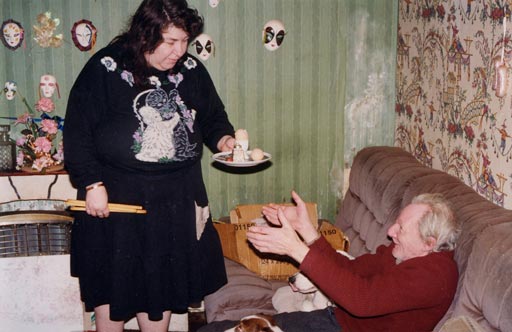
“My dad had moved into my mum’s place by this time and I could not believe how it looked. She’d had two years away from my dad so she had created her own psychological space around herself that was very ‘carnivalesque’ and decorative. There were dolls, jigsaws everywhere. She’d got load of pets by this time; she had about ten cats … two, three dogs.” (Richard (Billingham, In: ‘We are family’, Genius of Photography).

richard_billingham_3


4cdbf2154c73d9837016f17f848a35f3

(In 1997 Richard Billingham participated in the famous exhibition ‘Sensation’ at the Royal Academy of Arts, and was nominated for the Turner Prize in 2001)

giuseppe

Giuseppe Maria Mitelli. Il Mondo e per lo più gabbia di matti (1684).

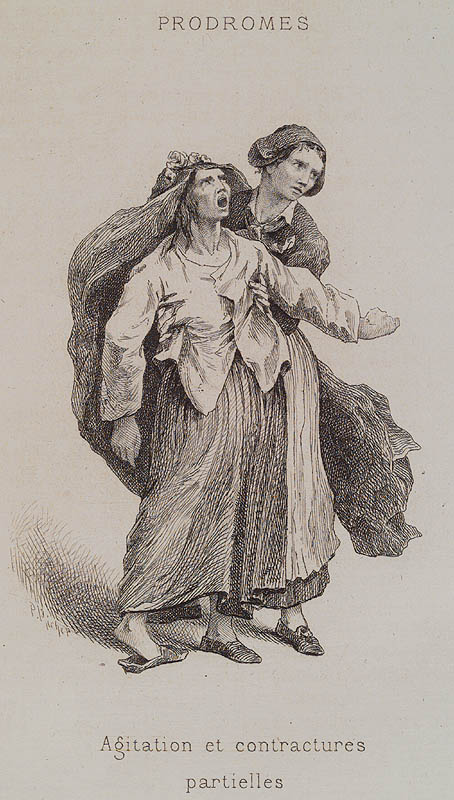
‘The tradition of visually representing madness in the form of various icons, whether physiognomy, or body type, gesture or dress, points towards the need of a society to identify the mad absolutely. Society, which defines itself as sane, must be able to localize and confine the mad, if only visually, in order to create a separation between the sane and the insane.’

Sander L. Gilman

(In: Disease and representation:Images of Illness from Madness to AIDS. Ithaca and London: Cornell University Press, 1988, p. 45)

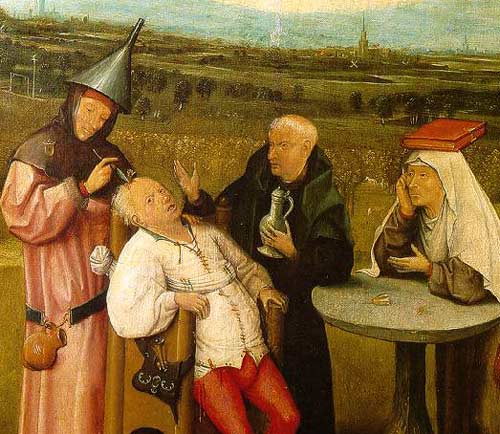
 ALEJANDRA PIZARNIK – EXTRACTING THE STONE OF THE MADNESS

pizarnik

Argentinian poet Alejandra Pizarnik’s book ‘Extracting the Stone of the Madness’ (Poems 1962-1972) will be released in April by New Directions. The translator, Yvette Siegert, was born in Argentina, lives in New York and has translated two other books by the same author, but this is the first full collection of Alejandra’s poems published in English. According to the editor, ‘Obsessed with themes of solitude, childhood, madness, and death, Pizarnik explored the shifting valences of the self and the border between speech and silence.’

Alejandra Pizarnik was born in Buenos Aires in 1936 to Jewish immigrant parents from Russian and Slovak origins. Her first book, La tierra más arena, was published in 1955. Alejandra studied Literature and Philosophy at the Universidad de Buenos Aires, and studied painting with Juan Battle Planas. She lived in Paris from 1960 to 1964, where she participated in the Parisian literary scene. She was later awarded a Guggenheim Fellowship in 1968, and a Fullbright Scholarship in 1971.

While living in Paris, Pizarnik translated Henri Michaux, Antonin Artaud, Aimé Cesairé and Yves Bonnefoy. She was influenced by the French symbolists, by Surrealism and also Romanticism – her poetry has a strange beauty, characterised by dark, condensed poems.

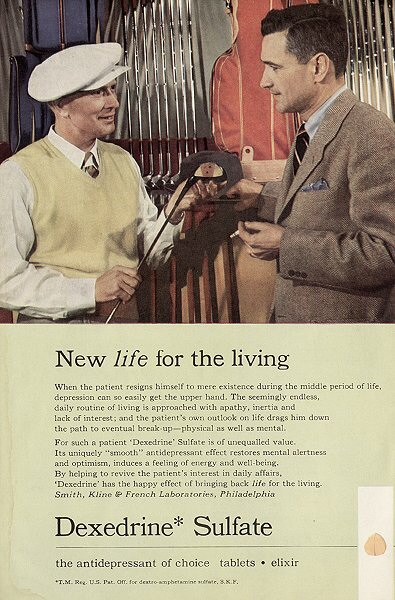
Alejandra Pizarnik was addicted to amphetamines, which she started using as a diet pill. She was also diagnosed with Borderline Personality Disorder.  She died in 1972 after taking an overdose of Secobarbital, during a period of a severe depression.

Yvette Siegert will discuss Pizarnik’s work at Oxford Comparative Criticism and Translation in February. Some of her translations of Pizarnik’s poems were published at Circumference Magazine.

Virna Teixeira